Tuesday, April 29, 2014

Sea Kayaking in Baja Mexico

The overall trip plan was centered around six days of guided Sea Kayaking, starting in the town of Loreto, Baja California Sur.   Loreto is about two-thirds of the way down the peninsula, with only two flights a day from the USA.

On Thursday, February 27th, my friend Mike was nice enough to  pick me up at home and take me to the airport bus.  I had an interesting conversation with the bus driver, mostly about the Boulder flood.

The first leg of my flight took me to LAX, where I would stay overnight.   I had an interesting conversation with my seatmate, a black lady who was in Management of Information Systems.  She got in that field 20 years ago, and you can imagine what a minority she would have been in that technical field.  She was working for Time-Warner cable, so we were both in the telecom field.

On the shuttle bus to the hotel, I found out that the driver was from Leon, Guanajuato, Mexico.  We ended up talking about the pilgrimage to San Juan de Los Lagos, which his father often made on foot from Leon, about three days.  He was impressed that I had walked 300 km in Spain.

All in all, very interesting conversations on my trip out here.  You do meet more people traveling alone.

On Friday Feb.  28th, I got up early to catch the shuttle to the airport, and the flight to Loreto.   I left LA in a rainstorm. The flight was a little late, a little bumpy, but we arrived without incident.

The breakwater in Loreto, with a seal sculpture

My hotel in Loreto was La Damiana, kind of a Bed and Breakfast without breakfast, with 7 rooms.
The Mission tower

I went to mission museum, which was somewhat interesting.  Loreto was the first capital of the Californias, dating back to 1697.
Loreto, Historical Capital of the Californias
Municipal Building


Since the start of Lent was a few days away, there was a Carnival parade, kind of low key, something for the locals, not the tourists.  It was kind of fun to watch.

Saturday March 1

I tried to join a whale tour, but no one was there.  The directions, from another tourist, were not very good.   I heard later that it was a great tour, they saw many whales up close.

I took a long walk, and eventually found the thatched roof bus station.   After a nap, I headed to the malecon (waterfront), and watched crabs.   Did you know that crabs could jump?

In the afternoon we had a trip meeting, where I met the group. There were seven guests, some younger, some my age.   There were three guides, Gini, Marco, and Andrew, a visiting guide from Washington state.

I had dinner at La Palapa restaurant with Sam, George, and Donna.

Sunday march 2

The van picked us up at the hotel, and we drove south to the beach at la Quemada (rattlesnake beach). Unfortunately, it was too windy to make the crossing to Danzante Island.  Instead, we paddled to Punta del Coyote, made loops in the waves, and practiced wet exits and reentry.   We paddled back to rattlesnake beach for dinner and stargazing.
Ann-Marie
Sam, me, Carol and George 

The kayak assigned to me was a Romany Surf, a British style kayak designed by Nigel Dennis for playing in rough water.   Unfortunately, I found the boat unstable and uncomfortable, which is not a good way to start a trip.   My own sea kayak is a larger boat, a Wilderness Systems Sealution, a North American style kayak.

Monday march 3, we got up at 6 am, to flute music.   Gini played flute music as a wake up call each day, kind of a pleasant wake up call.   After breakfast, we packed for the crossing.  I got very frustrated packing the boat, which had quite a bit less storage than my own sea kayak.  I kept trying to adjust the backrest to make the boat more comfortable, but nothing worked.   Finally Marcos inflated a water bag and stuck it behind me as a backrest, which did improve my comfort level.  We crossed to Danzante island in moderate waves.  We considered going on to Carmen Island, but the wind was building.   After we set up camp, we paddled to party beach at honeymoon cove, where we found another group, and were serenaded by a sailboat playing 60s music.  We climbed to the overlook, and some folks did some snorkeling.   In addition to my issues with the kayak, I was not feeling well, so the trip was not getting any better.

March 4 Tuesday, we paddled over to Carmen island, around N side of Danzante, in modest wind and waves.  I was feeling better, but a little shaky in the waves.


Rob and Gini

We made a brief stop at a small beach on the West side of Carmen Island, then proceeded to the southern tip, punta Baja.   Punta Baja had two palm trees, which provided welcome shade. We would spend two nights here.  I snorkeled a little.  Marco hand caught several fish for dinner, including triggerfish.   We had really fresh sushi.   The whole idea of hand catching fish was amazing to me.   The group sang happy birthday to me.
Sam
Mary and the boats


Wednesday march 5,  half of group went on a long paddle. The rest of us snorkeled with Marco. We saw a fair number of interesting fish, including the King Angelfish and some Parrotfish.  We also saw whales at a distance, including a blue whale, as well as dolphins cavorting nearby. This was my first time to see a blue whale, which looked like a small island.

Marco is amazing at spotting wildlife.  He grew up around the water in Baja, and started fishing at an early age.  You could really see that the sea was his life.  He said that he tried being a vaquero (cowboy) for a while, but the sea called him back.

After lunch we took a short paddle, where we met up with the other group returning. We also saw dolphins near our kayaks, and several sea turtles. We all returned together and had dinner. The view east included a red sky and sea, and a blue band in between.

Thursday march 6
Gini taking advantage of the glassy sea.
We got up fairly early to paddle to Danzante island. The sea was glassy, and we took advantage of conditions to just sit out in the middle, admire the view, and watch the sea life.   We saw manta rays swim under water, kind of flapping their wings, and jump high out of the water. We saw a lone sea lion. We saw a blue whale at half mile distance, even more impressive than the day before. We watched a long time mid-channel.  As we were getting close to Danzante, we saw a Brydes whale up close, perhaps 50 yds.

We paddled to aquarium beach, where some folks snorkeled.  Marco and Ginni fished with a handline, and caught mexican hogback fish for dinner.   The vegetation was surprisingly lush, considering that we were in a desert.


Ventanilla - Window

We moved to Ventanilla (Window) beach, named for the large rectangular rock opening.  We had a good dinner, mojo de ajo fish and pasta.   After dark, we went and ran paddles through the water, to see some bioluminescence.    It was an evening of stories.  George told merchant marine stories from Alaska and Vietnam.   Ginni told some sailing stories, including some big storms.

Friday March 7
Gini with our flute wake up call
Me in my boat
George


We got up early, and rock-hopped down the West side of Danzante Island.  That fun, playing in and around the rocks near the shore.  We stopped for a hike at Arroyo beach.  Some of us hiked to the top, where we could see both sides, including the venatanilla opening.

 We saw a guide putting up tents for his clients, who would arrive by sea kayak.   The guide and tents had been dropped off by a panga (powerboat).   I prefer the expedition style kayaking that we were doing, where we carried our own gear in our own boats.

We then paddled back to Rattlesnake beach, where we started, in a following wind and sea.  When we arrived at 1 PM, our taxi was there, and took us to Hotel Angra.  We met for a farewell dinner at the Giggling Dolphin.
Ann-Marie and Marcos

Gini and Andrew

Saturday march 8

I had signed up for a private lessons with Ginni.  We met at the beach in town, and started with some dry land exercises.   We went out and practiced, and I learned that I should be making my paddle strokes more vertical.   Ginni tried to get me to sit more upright, but my back muscles got tired very quickly.  We had taken out the backrest, trying to use the boat as the designer intended, but I was only able to sit upright for a short time.  We quit early due to my back pain and increasing waves.

I had dinner with Sam, and we agreed to share a taxi to the airport in the morning.

Sunday March 9

The plane left Loretto on time, and I cleared customs in LAX.   I headed over to United to catch my flight back to Denver.  When I got to the gate, they announced that the flight was overbooked, so I volunteered to receive a cash payment for being voluntarily bumped.   I was told to stay near the desk at the gate; some people were pretty upset, worried that they might be involuntarily bumped.   When it was all said and done, no one was involuntarily bumped.   I was the only person voluntarily bumped, as I was the first person to volunteer.   I got a $200 credit on United, as well as a hotel room and some money toward meals.

Monday March 10

I caught an early flight to Denver, took the bus to Boulder, and walked a couple of blocks home, to find my cats happy to see me.


For me, the highlights of the trip were our time on the beach at Carmen Island, and the still water crossing to Danzante, where we saw so much marine life.   On the good side, the guides were good, the scenery was spectacular, and the marine life was great.  On the bad side, I never really got comfortable in the kayak, and I did not feel well during the trip.   Would I recommend a sea kayaking trip to Baja?  Yes, but I suggest that you carefully consider the kind of kayak that you want to paddle.   I did not have any experience with this kind of kayak, so did not realize the extent to which the kayak would be a problem for me.





Sunday, January 19, 2014

Santa Fe and Home


On Tuesday morning, we got up and got going early, on the road before 8 AM.   The drive to Santa Fe was uneventful, and we checked into our usual campground, now called Suenos de Santa Fe.   The manager gave us information on the bus, which leaves from in front of the campground.  It worked very well, dropped us a block from the plaza.


The Cathedral was closed for a funeral, so we walked to the Loretto Chapel, with its famous double spiral staircase, with no center support.   This is sometimes called a miraculous staircase, due to its unique design, and the legends associated with its construction.  Cynthia remembers getting to walk up and down it years ago, because her kindergarten teacher, Sister Margaret Ann, was working in the gift shop.   My uncle Bill, a carpenter and a devout catholic, was very impressed with it.   He gave me an 8 by 10 photo of the stair about 50 years ago, and I still have the photo.


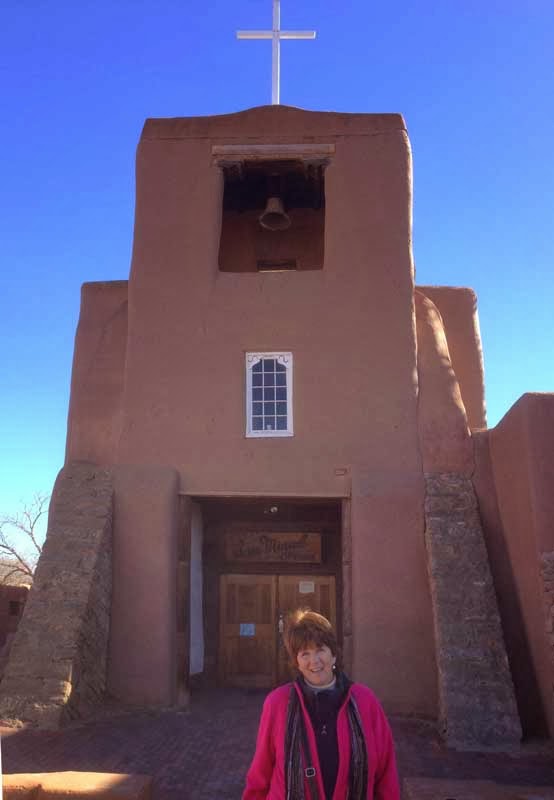
We then went into St. Michael's, the oldest church in the US, dating back to 1610, when it was a chapel for the Spanish soldiers.   In places you can see the original adobe walls.  The bell dated to 1356, so was even older than the chapel.

We then proceeded to the New Mexico statehouse, the Roundhouse, in the shape of the Zia symbol.  We found fine artwork on every wall, from 20th century New Mexico artists.  After viewing the top floor, we took a nice lunch break at Los Jalepenos restaurant.   After lunch, we returned to the capitol, to see even more artwork.   At some point, we hit the art overload line, and decided to leave.

We toured the Cathedral on our way home, famous for "La Conquistadora", a statue of Our Lady brought over from Spain, which survived the Pueblo Rebellion of 1680.  It was built in the French style by Archbishop Lamy, made famous by Willa Cather's book, Death Comes for the Archbishop.   The altar screen has images of eight New World saints, and we worked to identify them, including Katherine Drexall, Peter Claver, Rose of Lima,  and Katheri Tekawitha.  It is often a bit of a puzzle as to which saint is depicted in each image, but there are usually enough hints in the image, for a knowledgeable person to figure it out.

On Wednesday, we hit the art galleries.   We started at Nedra Matteucci, one of the older and better known galleries.  The jewelry expert there was able to show us a sample of Tufa casting, in which a piece of Tufa stone is carved as a mold for casting.   This was discussed in the Turquoise museum, but we had asked at other galleries, and no one knew anything about it.

We proceeded down Canyon Road, dropping into a number of galleries.  Some of the galleries did have interesting work.  When we went into a ceramics gallery, the lady turned on the lights, as we were the first visitor.  We chatted with her at some length.  She suggested that we go to the railyard area, which had interesting galleries.  After lunch at a cafe, we decided to go to the railyard.   The railyard galleries have more contemporary art.  Much of it was too minimalistic for our tastes, including a series of white on white paintings, each with a different pattern of rectangles.  The inflated metal sculpture was fabricated out of flat sheets, and then "inflated" with high pressure to form the shape that you see.

Inflated metal


The photo of the trains contrasts the old and the new.  The new is the "Railrunner", which is a commuter train which goes from south of Albuquerque to Santa Fe.   Our campground in Albuquerque was near a Railrunner station.


On Thursday, we got up early to drive home.  The drive north on I-25 was uneventful, sunny, pleasant, with light winds, and few stops.  We got to Cynthia's house at 2 PM, and I got home before 4 PM.  A good trip, but perhaps more desert and minimalist art than Cynthia would prefer.

Monday, January 13, 2014

Las Cruces and Albuquerque

We got underway before 9 AM on the 10th, heading for Las Cruces, NM.  The trip was less than 400 miles, but took almost ten hours.   The slow trip was the result of a combination of factors; we stopped a lot, but also fought a headwind, and rush hour traffic in El Paso.  The scenery was desert, similar to Big Bend, but less varied.

When we arrived at Chris and Gill's house in Las Cruces, we were able to pull into their side yard and plug in, replenishing our batteries, depleted after a week on generator power.   They took us on a small tour of Las Cruces, and then we had dinner at a Mexican restaurant, La Posta, in a historic building in nearby La Mesilla.

We visited the Museum of Art and the Museum of Nature and Science, next door to each other.  Perhaps the most interesting exhibit was Permian Trackways, with animal and insect tracks from pre-dinosaur times, about 280 million years ago.

Chris cooked us a nice dinner, and we said goodbye, knowing that we would leave early on Sunday.


At 7:30 AM Sunday, we pulled out and headed for Our Lady of Health Catholic Church, to attend the 8 AM Spanish Language mass, on the feast of the baptism of Jesus.   I found it comfortable to be there, kind of like going to church in Mexico.  After mass, I chatted with the lady doing the readings, who explained that some of the people at mass were from Mexico, but many of them were local.  Cynthia thought that many of the people seemed very devout.

After mass, we started our drive north.  Unlike our drive from Big Bend, we started with a full tank of gas, and only stopped once along the way, so we made good time to Albuquerque, arriving at the Isleta Pueblo Casino campground before 2 PM.  We headed over to the Casino to watch the Bronco game, and were pleased that the Broncos won.

On Monday we headed for downtown Albuquerque.  The telephone museum was inexplicably closed, but we wandered around Old Town, visiting shops, and then had a good lunch as the Church St. Cafe, green chili with chicken.   

We had signed up for a 1 PM tour of the Turquoise Museum.  It turned out that we were the only people on the tour.  Our guide was a member of a family with five generations in the turquoise business.  We learned about mines in the US and around the world, types of turquoise, and how turquoise is processed.   We also learned about natural, enhanced, chemically stabilized, and blocked turquoise.  The natural is the best and most expensive.  We thought that our tour was excellent (fabulous, says Cynthia).   The tour was supposed to last 90 minutes, but we asked a lot of questions, so it lasted two hours.  Very enjoyable and educational.  Unfortunately, photos were not allowed.


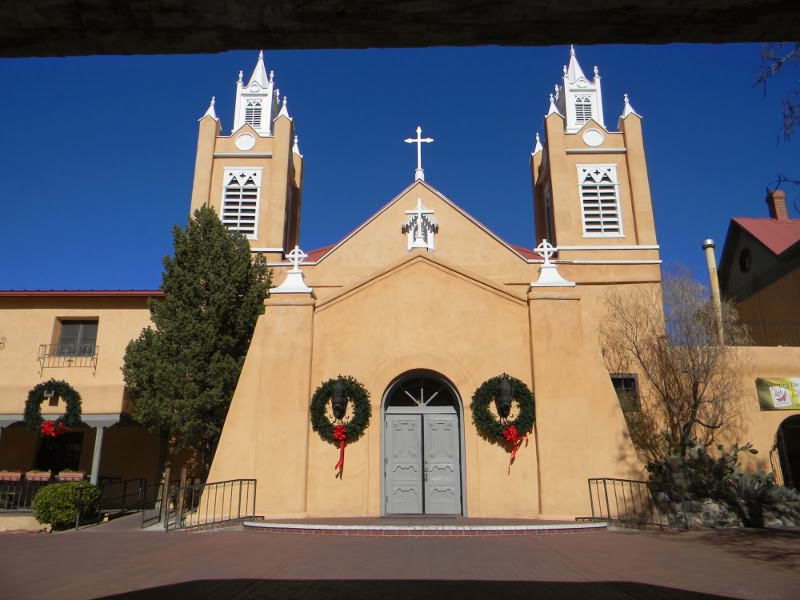
After the Turquoise Museum, we visited the historic Philip Neri church, on the plaza, stopped by the supermarket, and headed home to the campground.   Tuesday we drive to Santa Fe.

Saturday, January 11, 2014

Big Bend National Park


On January 6th, we left Big Bend Ranch State Park, and headed for Rio Grande Village, in Big Bend National Park.   The campground in Rio Grande Village was somewhat confusing, being divided into four zones, with and without generators, and with and without reservations.   After consulting with the campground host, we picked a site where generators were allowed, and it was first come first served.   It was bitterly cold, with a strong wind, so once we got set up we went into the camper and stayed there!  

That night,  Cynthia woke me up to say that the camper was cold;  I had forgotten to open the valve on the spare propane tank.   However, even after the valve was opened, the heater was not producing full output.   In the morning, after some head-scratching, I reset the propane system, by closing and reopening the valve slowly, and got things working normally.   I read somewhere that RVs have everything that a house has, plus everything that a car has, plus things that neither has.   All in all, campers are complex systems, and involve care, feeding, and repairs.


On the 7th, the weather was nicer, and we decided to take a short hike to the Hot Springs.   This was a commercial hot springs in the 1930s, and there were several buildings left from that time.  One can still soak in the 105F water.   The birding was interesting, including a Northern Cardinal, a Black Vulture, a Golden-Fronted Woodpecker, and the spectacular  Vermillion Flycatcher.   I chatted with some of the neighbors in the campground, including some traveling musicians, who had put on an impromptu concert.  We had to run the generator to keep up the battery, due to the cold weather.


Adobe bricks drying in the sun, Boquillas
On the 8th, we headed for Boquillas, Coahuila, Mexico.   Until 9/11, this was a popular day trip, no paperwork needed.  The border was closed until April 2013, when it was reopened, using a remote passport check station.  We hired someone to row us across the river, and also a guide, Martinez.   The town had depended on tourism from the park, so when the border closed, many residents left to find work elsewhere.    Now that the border had reopened, many buildings had fresh paint and new solar systems.   There was also a new health center and kindergarten.   Curiously, there were power lines in Boquillas that led nowhere; we were told that there were at one time plans to provide power to the town from the USA.   We chatted at some length with the friendly owner of the restaurant, who was fixing up the restaurant that his wife's father had built many years before.  


After we got back to the US, we washed our clothes and caught up with email.   There is no cell service here, but there is WIFI at the store.


On the 9th, we took a modest hike to a Rio Grande overlook.  We lounged around the rest of the day.   One amusing thing was the scene outside the store, where people at picnic tables made phone calls using WIFI, in a kind of open-air phone bank.  Cell service was not available in that area.  You learned everyone's business.  We struggled some to find a phone number for Cynthia's cousing Chris, but we finally reached Gill at his work.   We will head for Las Cruces to visit Chris and Gill on Friday the 10th.


Wednesday, January 8, 2014

Terlingua and Contrabando


On Saturday, we drove South.  We stopped in the Terlingua ghost town, where modest occupied houses are surrounded by stone ruins. The cemetery was quite interesting, a lot like a Mexican cemetary.


After stopping at the Big Bend Ranch State Park visitor center, we got on the river road.  The road parallels the river for fifty miles or so, all the way to Presidio.  It is a twisty up-and-down road, 40 mph or so.  We camped next to the river. It felt a little spooky to be camped with no other campers around, with Mexico just across the river.  A couple of vehicles stopped to look at the river, but that was it.    We were staying in the Grassy Banks campground.  No, there were not really Grassy Banks, mostly Tamarisk.


There was a rapid near our camp, creating a dull roar.  We heard the neighing of horses; we saw the horses on the Mexican side  the morning we left.

On Sunday, we went to Contrabando Creek for a hike.  First, we wandered through the old movie set, used in "The Streets of Laredo" and other movies.  Then we went for a hike along Contrabando Creek.   Contrabando Creek was used by smugglers to move contraband, including liquor and wax, from Mexico to the USA.

Contrabando movie set


The weather and our hike were pleasant; however, we saw no birds, lizards, or animals.  The terrain was rocky and rugged, with fewer different colors than in O'Keefe's New Mexico.  We did see some old mining equipment, and a gate to nowhere, with no fencing on either side.  We went out about two miles and then turned around.


Monday, January 6, 2014

Marfa, Art, Astronomy, and History


Marfa is a curious mix of East Coast Minimalist art and West Texas poverty.   As we were driving to Marfa on January 2nd, we saw a private jet land at the Marfa airport.

Marfa Courthouse

We were going to Marfa to take the Chinati Foundation tour of the installation art on the old army base.   The base was established in 1911 as a cavalry fort, and served as an army base until 1945.  It was also a German prisoner of war camp.    The army base, Fort Russell, was bought by the Dia Foundation, as a place for permanent exhibitions of Minimalist installation art.

Our tour was an all day tour, with a break for lunch.  Unfortunately, photos were not permitted.  We started with Judd's 100 aluminum boxes, spread over two buildings.  Judd's art was considered to be minimalism; I tend to describe it as rectangular.   The next stop was an installation in which a Russian artist portrayed abandoned Lenin-era schoolhouse,number 6.   Then we went to the arena, where the art was primarily the building itself.  Finally we went to town to see crushed car bodies.   Our last stop before lunch was a temporary exhibit, in which an entire building became like a camera body.  There was a lens in the south wall, and the view outside was projected, upside down, on the north wall.

We went to lunch as the very popular Future Shark restaurant, a spinoff of the Food  Shark food truck.    The wait was long, but the food was pretty good.   All steam table food, nothing cooked to order.   We kept seeing old cars around town with Food Shark written on the side.   We were unsuccessful in finding a coffee shop, even after being told by two different people where it was.  We found the street signage in Marfa lacking.


After lunch, we rejoined our tour.   The first part was of a series of buildings, all considered one installation, containing diagonal fluorescent tubes in various colors and arrangements.  We also saw Judd woodcuts, rectangular with lines.   Perhaps the most bizarre exhibit was a room with many small pencil drawings, which looked like various slightly smudged pieces of paper;   Cynthia envisioned the artist laughing at us.   There was also a room of poems, generally involving a lot of repetition, but which I thought were somewhat interesting.  We did not go over for a close look of the kilometer of groupings of concrete boxes....

Overall, we liked the Judd boxes and the Russian schoolhouse.   We were not impressed by our "docent" (tour guide), a young woman who did not tell us very much, mostly leaving us to wander and absorb the installation.  The tour was relatively small, 11 people; the visitors were mostly pretty quiet, perhaps at a loss for anything to say.   Cynthia would not recommend a visit to Marfa unless you are in the area, or a fan of Minimalist art.

After the end of the tour, we headed back to our camper, in Davis Mountains State Park.  I went up to look for birds at the bird feeders, but there were no birds feeding.


On January 3rd, we headed to McDonald Observatory for the guided tour.   We had considered the star watching party, but decided that it would be too cold.  The altitude of the Observatory is 7000 feet.   Our guide was Marc, whose enthusiasm for astronomy engaged young and old.   The focus of the talk in the auditorium was the sun, and he projected live images of the sun, including sunspots and solar prominences.   After the auditorium talk, we drove up to the 107 inch telescope, where we went inside the dome, and he moved the telescope and the dome, to demonstrate the mechanism.   He spent quite a bit of time explaining how the telescope works, and even how the scientists apply for telescope time.   After that we drove over to the new 10 meter telescope, which has about 100 small mirrors, and operates in a completely different manner than the traditional telescope.  Our group enjoyed the tour and our guide very much, and gave him a round of applause at the end.


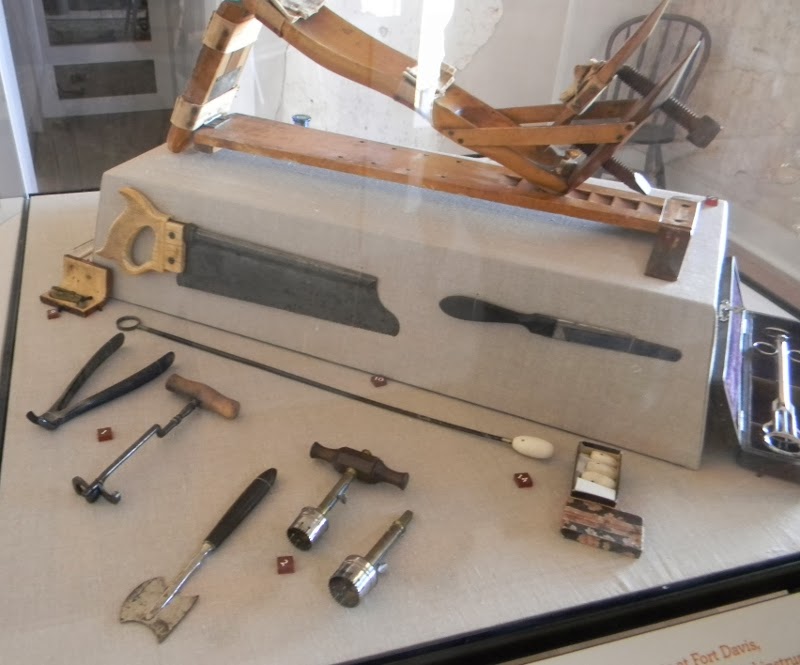
In the afternoon, we drove to Fort Davis National Park, the best preserved frontier fort.   Many of the buildings have been preserved, and some have been refurbished and equipped with authentic antiques.  The infirmary was especially interesting, including a collection of 1800s medical tools.  Both black and white soldiers were stationed at the fort; the introductory video was narrated by Kareem Abdul-Jabar.     The fort was deactivated in 1891.  A nice touch for visitors was the recorded bugle calls; the park provided a schedule showing what each call meant.  We found the fort interesting and informative.   The entire day was a great success.


Wednesday, January 1, 2014

Off to the great state of Texas

Off to the great state of Texas

On the 29th of December, Cynthia and I and the two cats headed south in the RV.   Destination, Big Bend, Texas.  Our first night we stayed south of Raton, NM, in the NRA Whittington center.  The campground had a 360 degree view, and visiting deer.

 On the 30th we continued south to Carlsbad New Mexico, and parked in front of my cousin Gemma's house.  We went out to dinner at a local barbeque place.  We enjoyed chatting with her.  She is the only one of her siblings still living in Carlsbad; her mother resides in an assisted living facility.


On the 31st, we ran errands in the morning.  One amusing thing was that the lady selling me propane asked me if I was kin to the family of the same name living in Carlsbad.  When I said that I was, she explained that she was a distant relative.  A small town.  In a surprising coincidence, Gemma's two sisters, Rosemary and Sue, were also in town, so we met for lunch at the Trinity restaurant.  This included their mother Madeline, and her brother Herb.   I had not seen any of them in some years, so it was good to see them.  


After lunch we headed south, to Davis Mountains State Park, where we set up camp as it was getting dark.    I had researched the mass schedule, and learned that there would be mass that evening in nearby Fort Davis.   The church was in excellent condition, after a recent restoration, and was more than 100 years old.    The priest was lively, and from the Philippines.  To our surprise, everyone was invited to a New Years Eve party in the church hall.  We went, and enjoyed a long and informative conversation with Angela and her husband Glen.  We learned that Fort Davis was a don't miss site, and that we should go to both the daytime and the nighttime tours at the McDonald Observatory.   We did not make it to midnight.


On the 1st, we went on a guided hike in the state park, walking the old CCC road to the scenic overlook.  There were about forty people on the hike.   We celebrated the new year at the top, where our ranger provided us with sparkling cider.  The elevation of the park is about 5000 feet.  

In the afternoon, we toured the Indian Lodge, also built by the CCC, and recently restored.  It was quite beautiful, in the Southwest style.