Friday, June 7, 2013

Exploring Colorado Springs


Like the native New Yorker who has never been to the Statue of Liberty, we live close to the town of Colorado Springs, but have never explored it. We decided to make a short trip to see the sights and visit the museums.


Our first stop was the Western Museum of Mining and Industry. The museum had several large working steam engines, as well as working models of stamp mills, dredges, and other equipment. I am of course always a fan of machinery. We were invited to try our hand at gold panning, but only turned up fool's gold. We had our photo taken with two of the burros in residence.

Cynthia especially liked the old photos of life outside the mines, including the town and the home. There were photos of baseball teams, 4th of July parades, a schoolhouse and schoolchildren, and a woman who took in laundry and told fortunes. Life was hard, but the immigrants came anyway, looking for a better life.

Our next stop was at Cheyenne Mountain State Park, near Fort Carson, south of Colorado Springs. Cynthia and I did some light hiking, under heavy overcast, on an unseasonably cool day.

We slept in on Thursday. Our first stop was to the Visitor Bureau. Besides the usual brochures and maps, we learned about an historical conference related to massacres. Cynthia called about the conference, and learned that it was full. We might be able to get in if there is a no-show, however.

We headed to the Fine Arts Museum. The upper floor was closed for an installation, but there was quite a bit on the lower floor. Perhaps the most impressive part of their collection was of New Mexico popular religious art, including crucifixes.


After a light picnic, we went to the Pioneer museum, which is a better than usual local historical museum, in the old courthouse. We learned a lot about the hospitals and sanitariums which cared for the people suffering from tuberculosis. The courtroom looked like it came right out of Perry Mason.
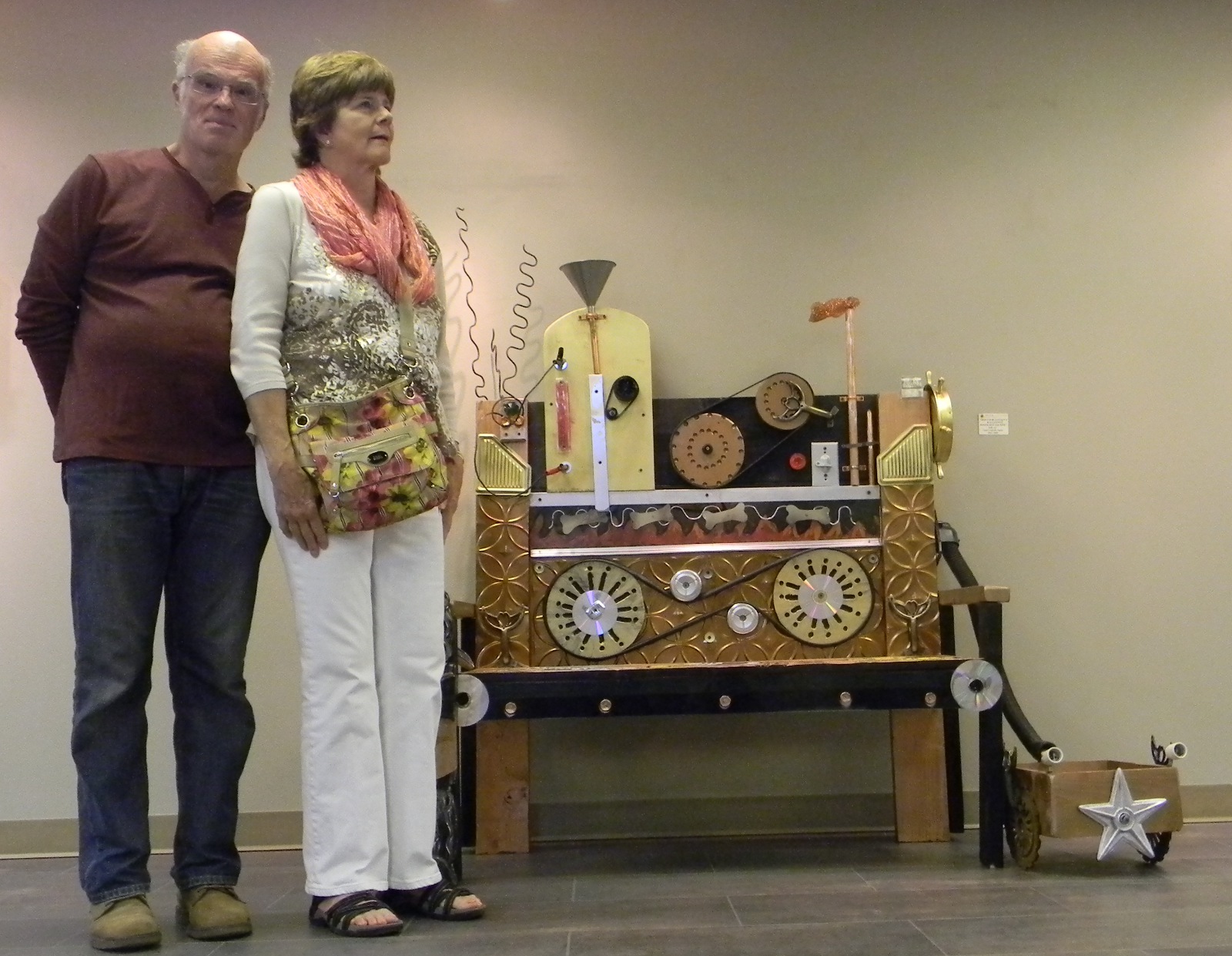
Steampunk art - Bonemaking machine

Our final stop was at the Cottonwood Center for the Arts, where many artists have galleries. We saw an exhibit which included many “steampunk” artworks. The photo of Cyntia and I is with a bonemaking machine.   


Wednesday, May 29, 2013

8 Days on the San Juan River


We had been planning to paddle the San Juan River in Utah for months.  But as the departure date approached, the flows steadily declined to below 300 cfs.  The usual lowest recommended flow is 500 cfs.  We were considering canceling the trip, when further research revealed that there was lots of water flowing down the Animas River.  Warm weather had melted the snow, resulting in 2000 cfs flows.   Our trip was saved by the Animas, which is undammed and untrammeled.  The water from the Animas reached our put in location two days before we put in!  Perfect timing.


The trip turned out to be three people, Randy, Wally, and me.  I was in my whitewater canoe, they were in inflatable kayaks.  The long drive over to Bluff UT was uneventful, and we camped near the put in.   The next morning we headed over to the ramp, which was a busy place, with multiple parties  hard at work packing their boats.

Randy looking over a wall at River House

Our first day involved many stops, including the River House ruins, and the Butler Wash rock art.  The steps carved into the rock were particularly interesting. We camped about mile 6.5.

Anazasi Steps
Butler Wash rock art panel

Our second day included Four Foot, Eight food, and Ledge rapids, as well as the narrows, with a camp around mile 20.

We noticed that we kept seeing collared lizards, day after day.


Our routine was developing, waking up around 7, getting on the river by 9 AM, getting to camp in the early afternoon, and then setting up a tarp to protect us from the sun, until the sun dropped behind the canyon walls.  Once the sun was down, we cooked dinner and headed for our sleeping bags.  Since we had a good current, we did not paddle much, mostly just drifting and watching the scenery.
Wally and Randy reading in camp


Our third day had us going through the town of Mexican Hat, named for the rock formation.  We stopped for lunch at the San Juan Inn.  Randy pointed out an apparent contradiction in the highway signs.  We camped just past Mexican Hat.

Randy is asking which sign do they mean


Our fourth day took us to the Honaker trail, built by a prospector.   We decided to hike it in the morning.  That evening we saw a herd of 30 sheep.  We ultimately saw more than 50 desert bighorn sheep.  How many sheep can you see in these pictures?

Wally with sheep in the background

Our fifth day had us hiking the Honaker trail.  From below, it is virtually impossible to distinguish the route, which goes back and forth through various shelves and cliff bands. 
Randy hiking the trail
Most of the way up there was a spectacular view of the river.  We proceeded to the top of the canyon, with a panoramic view, including Monument Valley.  This hike was the highlight of the trip for me.  We stayed a second night in the same camp.
Richard, with Monument Valley in the background

Our sixth day had the most excitement.  Ross Rapid had a large rock near the bottom.  Randy and I were able to get around it, although we almost bumped it.  Wally, the least experienced paddler, was not so lucky.  He hit the rock and was pinned by the current, his boat full of water.  Randy and I hiked back upstream and were considering rescue strategies.  However, Wally was able to work off the rock, losing some gear in the process.  Randy threw Wally a rope, while I went downstream retrieving gear.

We camped at John’s canyon.  There is a natural tinaca (tank of water) above the camp, but we were unable to locate a safe way to get up there.
Richard, thinking

Our seventh day included Government Rapid, the only class III rapid on this section of the river.   Randy and Wally elected to line their boats down, using ropes to move the boat along the bank.  I elected to run it, and ran it clean, just a little bump as I went past the big rock.  We stuck around to watch other groups run the rapid.   You can see my run at the link below, or just click on the photo below.

http://www.youtube.com/watch?v=ZRsAKEa6tm4


We proceeded to our only reserved camp, Slickhorn D.  In the lower part of the canyon, there are few campsites, so four campsites are located in a small area.  This was probably our worst campsite.
Randy, drifting down the river

Our final day was the longest day, 17 miles to Clay Hills.  Richard remembered bad headwinds the last time he was there.  A rafter also warned us of possible bad headwinds.  We resolved to get up early to beat the wind, which tends to come up midday.  We got up at 5, and were on the river by 6:15.  We paddled steadily, without wind, and arrived before noon, apparently the first party to arrive. 

The drive home started with 12 miles of dirt, and then took us through Blanding and Monticello.   Richard took advantage of his iPhone to research hotels and make some calls.   Many hotels were full in Moab, and the prices were high, due to the Memorial Day weekend.  We took the last room at a motel in Monticello, and were happy to have it.  The warm showers felt good.

We finished the drive on Memorial Day.  We were surprised not to see any backups or delays due to the holiday traffic.

A good and relaxing trip.

Most of the photos are mine, but the video and some of the photos were by Wally, thanks.


Saturday, April 20, 2013

Sea Kayaking Lake Powell


Note the snow covered peaks in the background

Three Colorado guys, Randy, Roger, and I, decided to go sea kayaking on Lake Powell.   Randy has vast experience sea kayaking in Alaska.  I am a beginner-intermediate sea kayaker.  Roger is a good boater, but new to sea kayaking.  For Roger and I, it was our first time camping out of a sea kayak.
Randy

Roger
Richard


We started out from Hall’s crossing on Sunday morning, April 14th.  The sun was out, but it was somewhat windy.  It was a five mile paddle in the main channel, open to wind and waves, until we turned into Moqui Canyon, where we paddled a couple more miles.   We did not find a campsite until we reached the end of the still water, where a trickle came in from a stream.  The lake level was about 3600 ft, about 100 feet below the full line, so we could not paddle to the end of the canyons.   We hiked up the canyon, looking for ruins.   We saw some rock walls under an overhang, but too far away to get a good photo.
Roger taking a break on the water

Monday we paddled to Forgotten Canyon, where we also paddled as far as we could, a total of about ten miles.  I stepped out of my boat and into boot-sucking muck.  My companions learned from my mistake and found a better place to get out.  We took a one mile hike to Defiance Ruin and petroglyphs.  The ruin has been restored, including the kiva, which you can see in the foreground.   
Petroglyphs at Defiance Ruin

A typical campsite
We were all tired at this point.  Our schedule usually had us up about 7 AM, paddling at about 9 AM, and then going to bed around 7 PM.  We rose with the sun, and hit the sack about sunset.    
We generally paddled as far as we could, to the end of the lake part of the canyon, and set up camp on a sand bar.   There were not a lot of good campsites.


As you can see from the photos, in many places there were unbroken walls, hundreds of feet high, with no place to get out of the water to rest or in case of problems.


Tuesday we found a sizable tailwind and following waves in the main channel.  You might think that a tailwind is a good thing, but the conditions forced most of us to paddle and steer hard to avoid getting sideways to the waves.  Roger, without a rudder, especially struggled to keep his boat aimed in the right direction.   We had originally intended to go further, to Cedar Canyon, but agreed that conditions were somewhat scary and dangerous.  We ducked out of the main channel at the first opportunity, Knowles canyon.  We paddled to the end of the canyon, and came back out to the main channel, where we found that conditions were worse, not better.   We camped near the mouth of Knowles canyon, going to the end of the first north side small canyon.

At this point, with the weather getting worse, our enthusiasm for getting further away from our car was very limited.  We had visions of being pinned down for a day of two of bad weather.   We agreed to start working our way back to the car, realizing that this might shorten the trip from the six to seven days that we had planned.

On Wednesday, at 6 AM, it was raining and 38 F.  We went back to bed.  We got on the water about 9:30, with the sky spitting rain and snow.   The sun came out, the conditions were blessedly moderate, and we took a break outside Forgotten Canyon.   We explored Hansen Canyon, where we camped conveniently near the mouth.  We had paddled about 7 miles.
Looking down on Hansen Canyon


The topography on this side of the canyon was not just sheer canyon walls, so we were able to take a hike.   This was our only real opportunity to get to where we could look down at the lake and cliffs.   We turned around when we encountered rain and sleet.


Thursday, we woke up to ice in our cooking pans, and a thermometer that read freezing.  We waited for the sun to reach our camp, and then packed up and headed out to Hall’s Crossing.   The sun was out most of the day, and we stopped for a couple of breaks.  We got a little confused about where the marina was located, and went out of our way, but found it in the end, paddling a total of about 9 miles.   We were happy to be back to our cars.  The photo below shows the gear that we got into our kayaks.


Randy headed south to Tucson, while Roger and I headed home to Colorado.  The wind in the afternoon was cold and biting, so Roger and I agreed on a motel in Moab rather than another night of cold camping.

Overall, it was a good trip, but perhaps April is too early to go paddling.  ;-) 

Sunday, January 13, 2013

The long cold drive home

We started out early on Thursday morning, heading west across the desert.  We had originally planned to stay in Gallup, but decided to press on in hopes of getting home in two days, to beat the cold weather. Cynthia continued reading Lonesome Dove aloud.    A long day of driving brought us to an RV park in Albuquerque.

Friday morning we did not get an early start, for a variety of reasons.  This meant that we would have to spend one more cold night out.   We ended up stopping in Trinidad Colorado, partly because the high winds had closed the road north of Trinidad, at least for high profile vehicles.  We walked around in downtown Trinidad, but did not stay long, partly because there was little open, and partly because it was bitterly cold.  We headed up to the campground in Trinidad Lake State Park, where we were the only camper.  

Saturday morning the thermometer read zero.  When we tried to dump on the way out of the campground, the valve had frozen shut!   (The valve opened up later).   We headed north to Denver, where I dropped off Cynthia and then headed back to Boulder.   A long hard drive home from Phoenix, but a successful trip.

Arizona


On Saturday morning, we got up early and got on the road by 8 AM, heading West on I-8.

The drive was uneventful, just mile after mile across the desert. Cynthia read Lonesome Dove to me to make the time pass. It got dark and we kept driving. Finally we got to our destination in Green Valley, south of Tucson AZ. We were greeted by Cynthia's friends Cynthia and Tony, old friends from Denver who have retired in Arizona. We parked the rig in front of their house. They had a beautiful dinner waiting for us.

On Sunday morning we went to mass at the historic and beautiful San Xavier del Bac mission church, on the Pima indian reservation. The mass was well attended, and was in both English and Spanish.

After mass, we headed to Tubac to wander through the shops and galleries. There were some interesting things there, and Cynthia bought a metal boot. We had dinner in Tubac with Cynthia and Tony. They love it in Green Valley, and have decorated their house eclectically, with fabulous finds from estate sales. We chatted more after dinner, and went to bed.


Monday we headed north, and decided to hike and camp in Tucson mountain park. We set up in Gilbert Ray campground, and went for a hike through the Saguaros. This is a somewhat greener desert than Anza-Borrego in California, some of the same cactus, but looking healthier. The photo of Richard is from our hike, while the photo of Cynthia is essentially the view out our rear window. Very beautiful, in the desert way.

On Tuesday we headed up to Phoenix to visit Eileen and see more art. We learned that Eileen's friend Barbara would be visiting as well. We headed out to the galleries in Scottsdale. We saw some amazing art, of all different genres, but especially Western art. We particularly liked the Russia gallery, where the owner told the story of going to Russia right after the collapse of the Soviet Union, and buying art from artists who really did not understand the art market.  We also visited the Contemporary Art Museum, where we saw a piece of installation art of an old trailer filled with red sand, a commentary on the housing boom.   Eileen fixed dinner for us and Barbara.

On Wednesday morning we learned that the weather in the next few days would be colder than we had expected. It might have made sense to head for Colorado immediately, but we were not ready to go. We headed back to the galleries in Scottsdale, and saw more excellent art. In the evening we all went out to the fancy El Chorro restaurant.


Thursday, January 3, 2013

San Diego


On New Years Eve, we got up for a guided nature hike. We did not find the organized hike, so we hiked it ourselves. This hike was up a wash to a “palm oasis”, where there were palm trees indigenous to Anza-Borrego. These are shorter palms with wider trunks than the usual palms that we see in the movies.

It turned out to be a relatively long drive to San Diego, through a mountainous desert area where gas stations were few and far between. We stopped at the California Welcome Center, where we picked up some brochures and maps. The GPS got us the rest of the way to Campland on the Bay.

Campland on the Bay was a bit of a trip, with kids everywhere and a New Year's Eve party atmosphere. The adult party started at 9 PM. We went out for dinner to a nice restaurant in the area, where we saw many young ladies dressed in their glittery outfits. We were tired and went to bed when we got back, but the loud music continued until after midnight.


On New Year's Day we headed north to the famous La Jolla. It was indeed very beautiful, with cliffs and sea lions and lots of upscale shops. After lunch, we continued north to Oceanside, to meet Terrie, one of Richard's metalworking friends from the internet. We had a nice visit with her, and headed home.

January 2nd had us headed for Balboa Park, the home of the famous San Diego Zoo and lots of museums. We tried to follow the signs for the Zoo, but ultimately had to stop and ask for directions. We should have used the GPS, which has been working very well for us on this trip. We finally found the Zoo, and then we could head south to the museum area. Balboa Park is huge. We started with the Timken Museum, where we admired the Russian religious icons, the Rembrandt, as well as 20th century American painters. Then we went to the Spanish Village, lots of small galleries but kind of a letdown after Rembrandt. We had a light lunch in the sculpture garden and then went to the wonderful Mingei museum. 


The Mingei museum was listed as a folk art museum, but almost all of what was there was made by highly skilled craftsmen or artists. There was a special exhibit on the color indigo, including two fascinating videos on the process of making indigo, which involves fermentation and an elaborate process to get blue die from green plants. We stopped by the supermarket on the way home and Richard got a much needed haircut.

On January 3rd we drove to Carlsbad CA to meet Erik and his new wife Leah.  Erik is the grandson of Cynthia's deceased husband, John.   Erik is studying to be a minister, in graduate school.


Our next stop was the impressive Maritime Museum, which consist of many historic ships, tied up to the dock.  The Star of India is the oldest active sailing ship in the world.  We also toured a US submarine.  

We closed our day with a visit to Coronado Island, and the Coronado Hotel, including watching the sunset from the beach.  We had dinner on the island, and then drove back to the campground.

On Friday, we headed back to Balboa Park to visit the San Diego Museum of Art.  We then took a very interesting tour of the Marston house, an example of Arts and Crafts dating from 1905.  We closed the day by visiting Old town San Diego, where we mostly gawked and wandered through stores.  There were several very old adobe buildings.  

Saturday morning we will get on the road early for our next stop, Tucson.


Anza-Borrego


Cynthia took the last flight from Denver to Las Vegas on Christmas day. I picked her up at the airport at 10:40 PM, all went smoothly there.

On the 26th, we made a big grocery store visit, since we needed to stock up for the desert. Between getting to bed late the night before, and the shopping, we did not get on the road until about 10 AM. The drive south had us going across a vast desert, essentially vacant except for roads and railroads. At one point we stopped at a parking area for a long dead business to have a bite to eat, as it was one of the few places one could pull over. The drive was made more tolerable by a book on tape, Killing Lincoln, so we spent the trip immersed in the civil war.

As it got late in the day, we finally saw the Salton Sea, and passed through the town of Mecca. We kept driving south, with the moon sparkling on the Sea, until we turned west. It was fully dark, and we kept driving. Finally we saw the sign which marked our turn onto the dirt road to find our camp. Tom was waiting for us and led us to a large flat area, with a 360 degree view. We were glad to stop.

We slept in on the 27th. Tom and Joan brought their own lawn chairs and joined us, basking in the sun and chatting. We decided to go to the village of Borrego Springs, eat lunch there, buy gas, go to the park visitor center, and see some of the metal sculptures around the area, which were quite interesting.


On the 28th our main activity was a hike to an ancient indian site, where you could see the metates, the worn in depressions in the rocks, that they used to grind grain. We also found the one and only century plant that was blooming. We headed back to Borrego Springs to see more sculptures; there are approximately 200 metal sculptures, all by the same artist. We were impressed, especially when we considered how many sculptures there were, and how quickly he must have worked. We invited Tom and Joan to dinner.


On the 29th we went jeeping. We were in an area with more jeeps, SUVs, and off road vehicles than we could imagine. It had a bit of Mad Max feel to it. From one overlook we estimated that we could see 200 Rvs of various sizes, with accompanying off road vehicles. We even heard an ice cream truck working the camp area. The jeeping varied from flat plain to bumpy rides in dry creek beds, to full sand dunes. We almost got stuck going up one sand dune, but Tom was able to back down. With the sand, you needed to keep your speed up, and we hit some pretty big bumps. When we stopped for lunch we saw fluid leaking to the ground, near the right rear tire. The brake line had been sheared, apparently in one of the big bumps. We continued, a bit more cautiously, and went up Carrizo wash until we got to the signs that said “Area closed. Unexploded ordnance.” We headed home and hosted Tom and Joan for drinks and hor d'oeuvres.

On the 30th, we said goodbye to Tom and Joan, who were starting their drive home. Cynthia and I  went to the appropriately named St. Richard's Catholic Church for Sunday mass. After a grocery store visit, we went back to the camper to pack up for Agua Caliente park, where there is electricity that doesn't come from a generator, more or less unlimited water, and hot pools. A bit of civilization to get us cleaned up and ready for the big city of San Diego. The hot pool was crowded during the afternoon, so we came back around 9 PM, when we ended up having the pool to ourselves.