Sunday, July 7, 2013

Fete du Rillauds, Brissac-Quince


This weekend is the Festival of Rillauds here in Brissac-Quince. The Rillaud is a local delicacy, otherwise known as a pork belly.


Cynthia made a potato, goat cheese, and egg torte.  The eggs were from our own chickens!  The recipe came from a cookbook which Cynthia bought in the Chateau Brissac gift shop. 


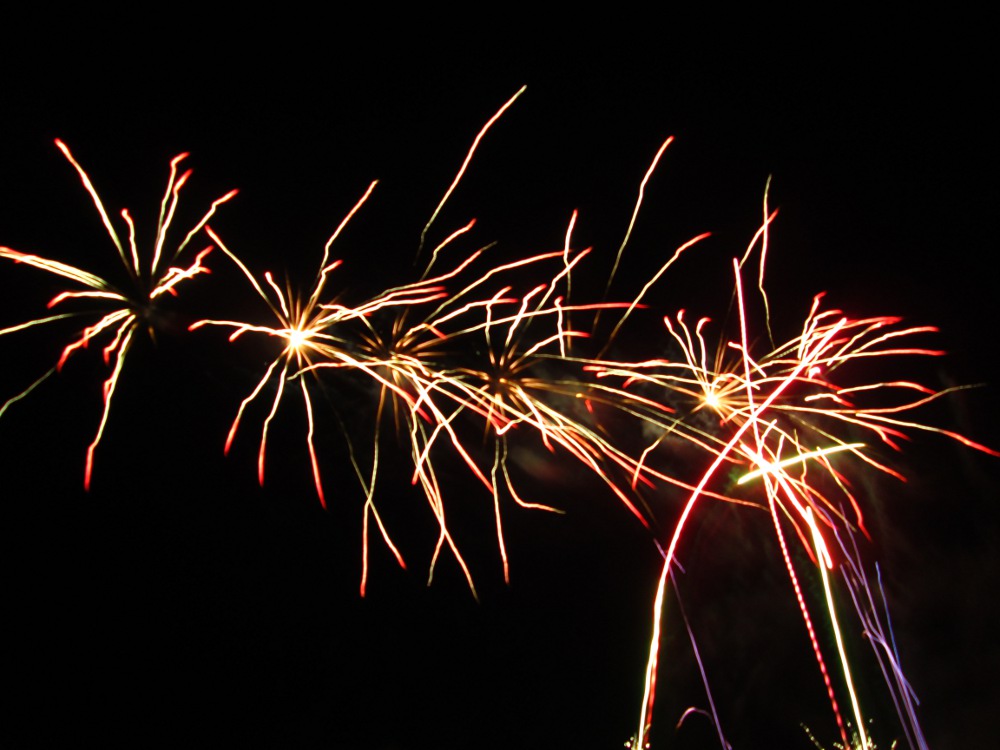
The festivities started with a dance and fireworks Saturday night. The dancing started off slowly, so we bought a couple of glasses of wine, 1 Euro each, cheaper than a soda here! The fireworks started at 11 PM, because the sun sets very late. The show was pretty impressive, given that it was a small town.


The dancing picked up after the fireworks. Everybody but us knew the words to some of the songs. We got out there and danced. We left at midnight, but the party went on.

Sunday we went into town for the giant yard sale, in French an “Empty the attic sale”. There were of course also Rillauds to eat; we had a sandwich. It was tasty, but pretty fatty food, and probably would be illegal in Boulder. (A small joke).

Rillauds - Pork Bellies

Banda du Rillauds

We walked up and down many streets, lined with vendors.  It looked like any yard sale in the USA, except that the books were in French.  Cynthia bought a toy fire truck as a gift, and also a tablecloth.  A few people were in local costume.


When we got back to our house, we watched the end of stage 9 of the Tour de France. We plan to be a spectator on Thursday, maybe we will be on TV!


Tomorrow we will be on the road to Pont-Aven, a town made famous by Gauguin and other artists.

Saturday, July 6, 2013

Chemellier, Brissac and Angers

July 3rd had us wandering through the countryside.  I saw a small sign reading "Dolmen", so we took a hike to see a very ancient monument, perhaps 5000 years old.


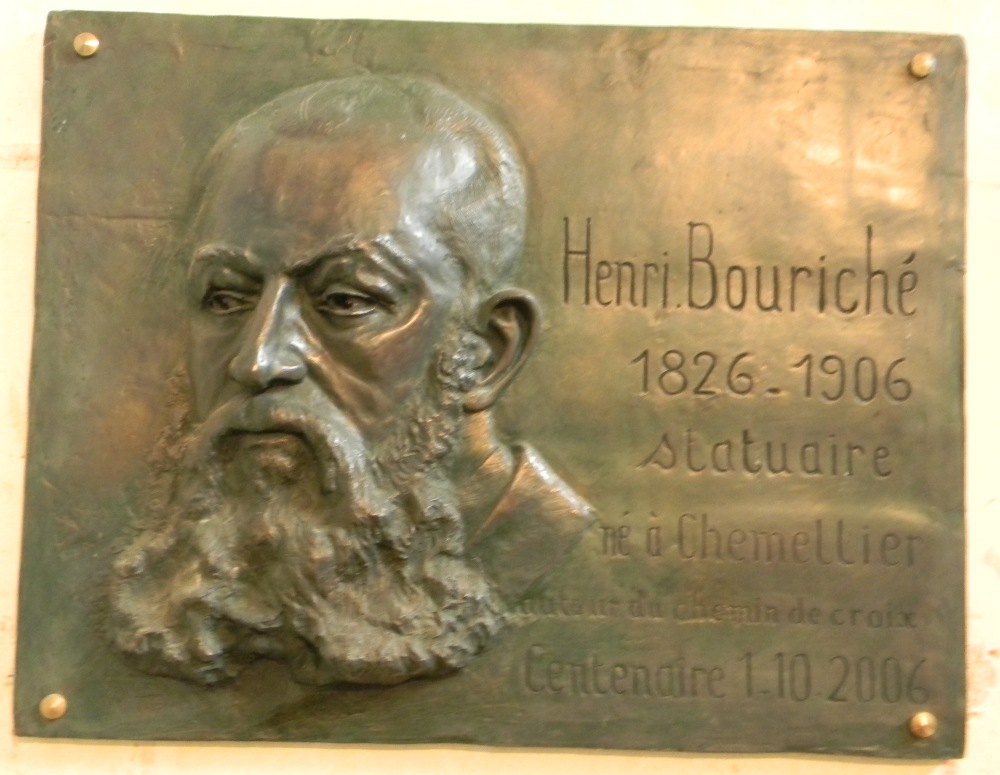
We met some Americans on the hike who raved about the local church in Chemellier.  We stopped, and were very impressed by the stations of the cross inside, huge and of high quality.


The stations were by a sculptor born in Chemelier, Henry Bouriche.  The church is a relatively new one, built around 1875.


We ended the day in the little town of Les Rosiers-sur-Loire, on the river Loire.  Cynthia bought some gifts in the gallery for local artists.

The monument to the soldiers lost in WWI and WWII had a small addition that caught my eye, the names of the Jewish deportees from WWII, one of whom was a girl of 7 years old.


The 4th of July found us shopping in the weekly market in the town square of Brissac.


We then headed for the Chateau of Brissac, the tallest Chateau in France.  If you look very closely in the photo below, you can see a human being, dwarfed by the scale of the chateau..


The towers of the chateau were part of the old castle, torn down to make the chateau.  The plan was to eventually tear down the turrets as well, but the duke died, so work stopped on that.  The turrets are basically free standing.


July 5th had us headed back to Angers.  We stopped first at the Collegial church of Saint Martin.  There has been a church there since the 5th century, so many churches and so many modifications that it is quite confusing.  The coffin is of slate, a famous local product.


We had a pleasant lunch, outdoors in the square in front of the fine art museum.


We also visited the fine art museum, where this painting caught my eye.  It is portraying the Bible story of Jesus in the temple, inadvertently left behind by his parents.  The painting depicts the moment when his parents found him, and were upset that he had gone off.  He told them, "why were you searching for me?  Didn't you know I had to be in my Father's house?"   


We took the tram back to our car.


We are starting to take advantage of the fruits and vegetables in the garden here.  This is Cynthia picking cherries.


Thursday, July 4, 2013

Our home away from home


We have had some requests for photos of our exchange house in Brissac.

The house is three stories, with a family room upstairs, three bedrooms on the main floor, and a basement/garage.

The house is very clean and the windows are spotless.  The shutters are functional; many houses here have the shutters closed, for some reason unknown to us.


Front of house
Rear of house
.
Relaxing on the rear deck

The tightly organized and compact kitchen has an island with bar stools.

View of kitchen from dining area

Living room

Richard at the dining room table going over tourist information.
First floor bathroom

Master bedroom
Vegetable garden

The yard is quite large, and they take advantage of the large yard to have a large vegetable garden and chickens.

The house is comfortable and more than adequate.

We hope that the French are enjoying our house as much as we are theirs.

Wednesday, July 3, 2013

Angers

On Tuesday the 2nd, we decided to head into the nearby city of Angers.   We drove in towards the center of town until we saw a sign for the tramway (light rail).  We parked there and took the tram into the city.

The historic center of Anger is as one would imagine a medieval town, old buildings and narrow streets.  The street that we walked down was lined with fancy clothing shops.

Our first stop was the Maison d'Adam, which sold art and crafts.  Cynthia bought copies of an old photo of rugby players, with an ironic commentary, as gifts for her boys, who played rugby.

Our next stop was the cathedral Saint Maurice, which was huge and impressive.  It was built in the 12th and 13th centuries.  One of the interesting aspects was a stained glass panel depicting the life of Saint Eloi, a goldsmith, who is a favorite saint of mine.


We had a nice lunch outside at the restaurant La Ferme.

Our final stop was the Chateau/Castle of Angers, which was huge and impressive.  It is hard to depict  the size in photos.  It was surrounded by a huge dry moat containing gardens.

The Tapestry of the Apocalypse is kept there.  It was made around 1370, and depicts the entire book of the apocalypse.  There were six sections, 20 feet high by 80 feet wide, containing 90 scenes.   It is truly impressive, especially the scale of the work.  It is one of the oldest medieval tapestries to survive.
The fall of Babylon

We took the tram back to the car.  We were very concerned about getting our car out of the parking lot; we picked up a card when we entered the parking lot, but we had tried to pay the parking fee without success.  However, when we got the car to the gate it just opened, without us inserting the parking card!  Much concern about nothing.  We got confused getting out of the city, but stopped for directions.

There is a lot to see in Angers, so we will be back another day.


Tuesday, July 2, 2013

Brissac and Saumur

Saturday we walked around and discovered the town a little. We stopped in the tourist office and looked at their artist gallery. We made a lengthy visit to the church in Brissac-Quince, St. Vincente en Aubance. We saw a large gathering at the school, a party for the end of the school year.


Richard feeding the chickens

Saturday evening Jean-Marie and Marie-Helene took us to a free concert by Barbara Hendricks, an American opera singer who now lives in Holland. For this concert, she sang blues, but ended with several songs from the civil rights era, including “Strange Fruit”, a Billy Holiday song about lynching, which I had never heard performed.

On Sunday, we went to mass in the nearby village of Les Alleuds; it was well attended. Having read about a special event in the nearby city of Saumur, we headed for the military tank museum there. This museum includes 200 armored vehicles, from Europe and beyond, starting in World War I.
Cynthia and a Tiger Tank
The German Tiger tank was perhaps the most impressive, and one of the largest.  There were people playing tabletop war games, and several Germans in historical bright red military officer costumes. We at some point hit the overload line in terms of how many vehicles we could look at and absorb. We learned from the Germans that the big event was not at the tank museum, but a reenactment of various wars at the cavalry museum. These are similar to civil war reenactments held in the USA, with firing of blank shells in rifles and cannons.

 The first reenactment that we saw was from the Franco-Prussian War of 1870, in which the Prussian soldiers were obviously better armed and trained than the French troops of that time. In the real events of 1870, the Prussian victory was swift and complete.

The French had the colorful Zouave uniforms with red pants, while the Prussians had more conventional blue and white uniforms; their helmets had a large spike on top.
We also saw some reenactments of World War II, including the Normandy invasion, tanks, and machine guns.
 We spoke to a young man who was a reenactor; he liked WWII and the British, so he joined a group of British paratroopers stationed  in North Africa, as part of a communications unit.  He indicated that one chooses which army and which unit to join.  He buys the uniform and equipment for that unit, and studies the history of the unit.  Most of the reenactors in France are French, as one would expect.

We took the scenic route home along the Loire river, through many small and picturesque villages.

Monday was a rest day, in which we went to the store, and reviewed our pile of tourist information. We had a glass of wine with our neighbors, and admired their garden.


Friday, June 28, 2013

Paris and the Loire Valley


On Wednesday the 26th Cynthia and I were dropped off by Kelly at the Denver airport, bright and early, for an 8:30 AM flight to North Carolina. We had lunch in Charlotte, and then caught the flight to France. As usual, we slept little, but after an uneventful flight, arrived in Paris at 7 AM. We caught the Rossibus into town, and then had to wait a while to find a cab to our hotel.

Our hotel was La Manufacture, named after the drapery and tapestry company that previously had been in this area. The lady at the front desk was very friendly and helpful. Our room was fine, although small.


We had resolved to stay up as long as we reasonably could, so we headed off for the Chapel Saint Chapelle, famous for 13th century stained glass, telling the entire bible story. This chapel was built by King Louis IX, later Saint Louis. The stained glass is currently being restored, but most of it was visible. Impressive, especially given the area of stained glass. It would have been nice to have binoculars to look at the upper stained glass, which was hard to see. There was also impressive stone carvings.  The chapel is part of a government building complex, so we had to go through security.
Bridge over the River Seine

We were getting tired, so we stopped for lunch. After lunch, we decided to go to the Middle Ages Museum, sometimes called the Cluny Museum, where we saw more stained glass, but smaller panels close up. There were also many statues, tapestries, and other objects from the Middle Ages. However, Cynthia was starting to fade, so we left without seeing the entire museum, and and took the bus back to our hotel.


We went to bed around 7 PM.  We had been up for 30 hours.  Richard woke up and saw 9:30 on his watch.  He saw light outside, not realizing that the sun sets very late this far north, and figured that it was 9:30 AM the next day, so we took showers and started to pack.   Cynthia was complaining about her bloodshot eyes.  It turned out that it was really 9:30 PM, so we went back to bed. He learned that the time on his iPhone does not say AM or PM, assuming that one must know which is which.  But this is not a good assumption for a jet lagged tourist. His watch does say AM or PM, but in tiny letters.

Friday morning we woke up at 9 AM, and went out for a substantial breakfast. Then we went to a supermarket to get some food to eat lunch on the train, but that meant that we left the hotel later than we intended. We took a taxi to the Gare Montparnasse, where we rushed around and had to ask for directions to find our train.  We boarded the train with 15 minutes to spare. The TGV is the Tren de Grand Vitesse, the high speed train. At some points we could see that the train was going much faster than cars on the nearby highway.

We were picked up in Angers by our French neighbor, Jean-Marie, and taken to our delightful house in the small town of Brissac-Quince.  This is the house that Richard exchanged for his house in Boulder.  We will be here about three weeks.


Sunday, June 9, 2013

More Colorado Springs

Friday, we started our day with a little hiking around the Garden of the Gods, a famous park with spectacular rock formations. This is of course very popular, but still worth doing. This park was donated to the city by the family of a prominent citizen, around 1910.


We stopped at McDonalds to use their WIFI to check email and post to the blog. Looking at Trip Advisor, one of the recommended restaurants was Bird Dog BBQ. This was out of the way, but very good food. We both had the daily special, the Brisket Sandwich. Unlike many barbeque restaurants, the meat was not marinated in barbeque sauce; you could choose your own sauce from the table.

On the drive, we were both somewhat amazed at how large Colorado Springs has become; it was seemingly endless housing developments.


We then headed out to the Pro Rodeo Hall of Fame, which was Cynthia's idea. Most of the museum consisted of glass cases containing photos, text, and objects, related to famous rodeo people. There were also bronze sculptures, saddles, and other displays. Although Cynthia and I have been to some rodeos, we are certainly not steeped in rodeo history, so almost all the museum was new information for us. The museum is surprisingly large. Ultimately, we suffered from burnout, leaving after more than 2 hours. Although it was somewhat interesting, I felt that it was primarily of interest to rodeo aficionados.

Contrary to Richard, I thought that the Pro Rodeo Hall of Fame was stunning. The glass cases have individual photos of famous riders, pieces of their personal equipment, and the reasons why they are in the Hall of Fame. The displays were grouped by rodeo events; ie calf roping, bulldogging, bullriding and such. There is a room devoted to Chris LeDoux, his music, and his rodeo accomplishments. If you know nothing about rodeos, you will come away in awe of the athleticism, danger, and brute power on display at a rodeo. Very nice bronze sculptures, usually of a bucking horse, are displayed throughout; the 2D art is forgettable. Your next winning bar bet: Deer Trail Colorado held the first ever rodeo. Cynthia.

A chicken with feathered legs, held up for inspection.

Saturday morning we slept in, and started our morning with “Ranch Day” at the state park. Rangers and volunteers had demonstrations and activities related to ranching, for the benefit of us city folks. We learned about chickens, saw a dye demonstration, and learned a great deal about the brands used in ranching.  Branding is not obsolete, and we were told that if we are ever invited to participate or watch a branding, that we should be sure to do so, as it is quite a big deal.  The calf is roped, branded, innoculated, castrated, and tagged, a hard day for the calf.  Cynthia says to enjoy your hamburgers!   Richard is thinking about making a New Age brand, suitable for Boulder. Rather than a Lazy L brand, perhaps a Flying Buddha brand. ;-)

Our next stop was “Old Colorado City”, the original territorial capital of Colorado. We saw the log building which was part of the territorial capital. We visited art galleries, and walked by many souvenir shops. We looked at miniature city scenes in one shop, walked through the farmer's market, and generally took in the area. We had a light lunch at a tapas restaurant, and finished our visit by going to the Agia Sophia coffee shop and bookstore. Downstairs, it looked like any coffee shop. Upstairs, it was a bookstore of religious books from the Russian and Greek Orthodox tradition. The name of the coffeeshop is a play on the famous church in Constantinople (Istanbul) , the Hagia Sophia.

We then visited the money museum, which had a special exhibit on money and the Civil War. The Union printed paper money to cover the cost of the war, while the confederate money, promising cotton after the end of the war, suffered from extreme inflation. As in most aspects of the conflict, the Confederates had disadvantages in the field of money, including poor tax collection and a lack of engraving facilities.

We went to church, had a quick dinner in the camper, and then went to square dancing at the park, which was part of Ranch Day. A good time was had by all at the dance, young and old.

A very full Saturday, but very enjoyable.


Sunday morning we went to the May Museum of the Tropics, a bug museum. A lot of bugs in glass cases, including some spectacular ones, but not very much text or context. An amateur collection, but still impressive. A reminder of the difference between a professionally curated museum and an amateur museum.


On the way home, we stopped in Falcon for Richard to visit his Firebird sculpture, which he had not seen since it was installed in 2009. It looked about the same as when it was installed, so that is good.

The drive home was uneventful. We are now looking forward to France, while Richard needs to get ready for the Loveland Sculpture Invitational show in August.